
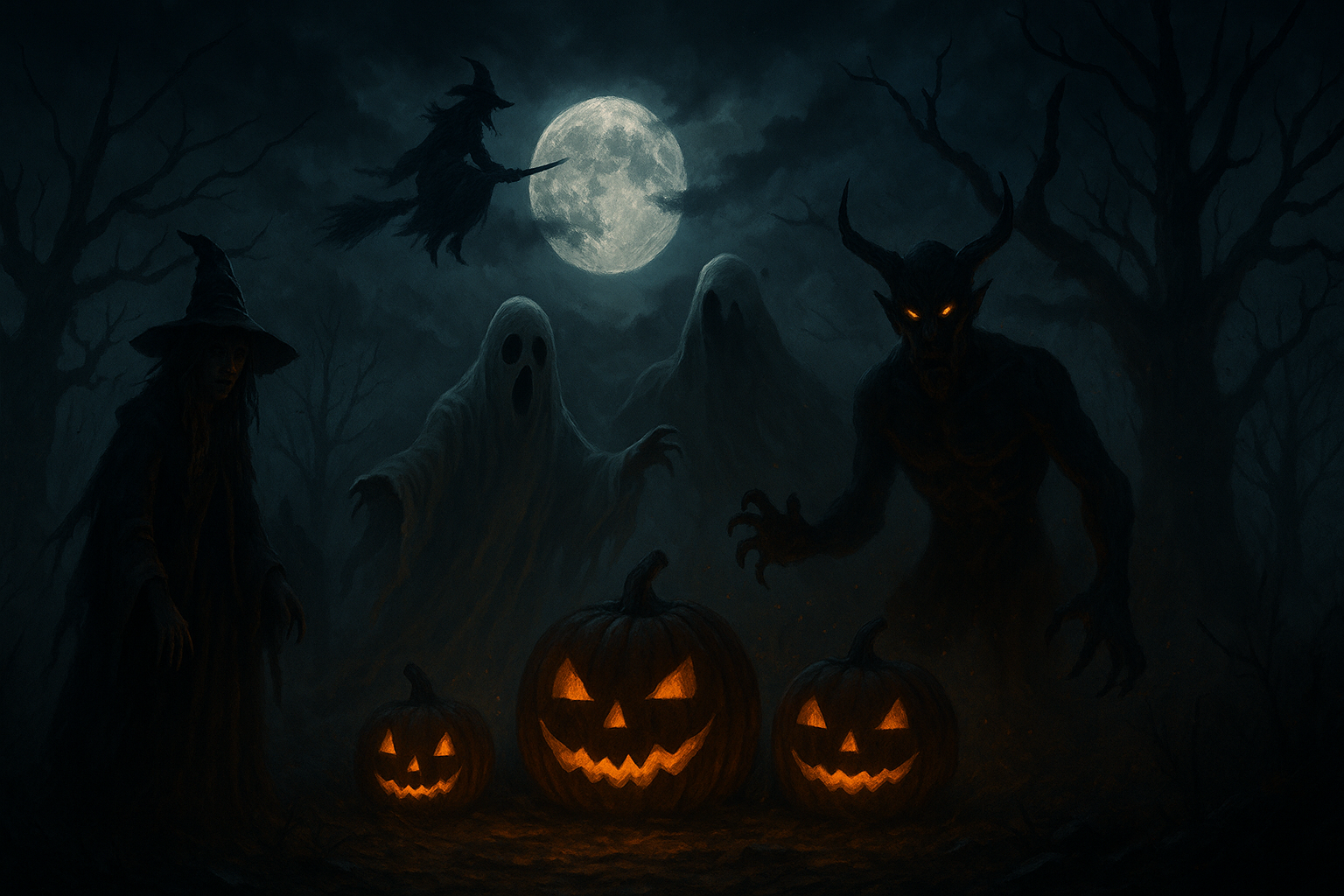
The History of Halloween — From Samhain Fires to Trick-or-Treat Nights
By Dale · 31 October 2025
Long before pumpkins and fancy dress, Halloween was a night of fire and fear — a time when Celts lit bonfires to honour the dead and protect the living. Over centuries it evolved through church feasts, medieval mischief, and American reinvention, yet its heart remains the same: a celebration of light meeting darkness, and life standing proudly in the face of death.
Introduction: The Eve of Shadows
As the final light of October fades, the world seems to hold its breath. The air sharpens, leaves crunch underfoot, and candles flicker in hollowed pumpkins. It’s Halloween — a night of masks, mystery, and mingled fear and fun.
But beneath the costumes and sweets lies a festival with roots far older and deeper than plastic pumpkins or horror films. Halloween’s story stretches back thousands of years — a journey through Celtic fire festivals, medieval church feasts, and the immigrant melting pot of America, where old customs found new form.
Tonight, as the clock ticks toward midnight, let’s step back through time to trace how the most haunted night of the year was born.
Part I: Samhain — The Celtic New Year of the Dead
Long before Halloween, the ancient Celts of Britain and Ireland celebrated Samhain (pronounced Sow-in). It marked the end of harvest and the beginning of the dark half of the year — a turning point between abundance and scarcity, light and shadow.
For the Celts, time itself was cyclical, not linear. Samhain wasn’t merely a date on the calendar; it was a threshold — a moment when the veil between the worlds of the living and the dead grew thin. Spirits, ancestors, and otherworldly beings could cross over, roaming freely in the mortal realm.
Fires blazed on hilltops to honour the gods and ward off mischief. Villagers lit torches from communal bonfires and carried the flames home to rekindle their hearths, symbolising protection for the winter months ahead. Livestock were brought in, crops stored, and divination games played to glimpse the future — particularly regarding marriage, fortune, and death.
It was not a night of evil but of balance — a recognition that death and life were part of the same eternal cycle. Yet fear was never far from reverence. People left offerings of food and drink to placate wandering spirits or to guide ancestors safely home. Masks and disguises were sometimes worn to confuse malevolent beings, a practice that would echo down the centuries as modern dressing-up.
Part II: The Christian Transformation — All Saints and All Souls
As Christianity spread through Europe, the Church sought to weave its holy calendar around existing pagan customs. Rather than suppress Samhain, church leaders reframed it.
In the 8th century, All Saints’ Day — also called All Hallows’ — was fixed on 1 November, to honour saints and martyrs. The night before became All Hallows’ Eve — which, through the slow alchemy of language, evolved into Hallowe’en.
A day later, on 2 November, came All Souls’ Day, dedicated to praying for the departed. The trio of observances created a Christian season of remembrance that coincided with older beliefs about the dead returning home.
Across medieval Britain and Ireland, traditions merged. People began to “soull” — visiting houses to pray for the dead in exchange for small cakes, called soul cakes. In some regions, children carried lanterns made from turnips and recited verses at doorsteps, echoing both charity and ritual.
The blending of pagan and Christian observances produced something uniquely enduring — a festival of both faith and folklore.
Part III: Medieval Superstitions and Festive Mischief
By the late Middle Ages, All Hallows’ Eve had acquired a distinctly earthy flavour. Alongside prayers for souls, there were games, plays, and plenty of revelry. Fire rituals continued, now tied to protection against witches and evil spirits rather than to Celtic gods.
Fortune-telling became a favourite pastime. Apples and nuts, abundant after harvest, featured in divination games predicting romance or destiny. Bobbing for apples, for example, was said to reveal one’s future spouse — whoever bit first would marry first.
Meanwhile, the idea of mischief took hold. In Scotland and parts of Ireland, young people played tricks, overturning carts, removing gates, or scaring neighbours. This “Mischief Night” element would later resurface in modern trick-or-treating.
The church bells tolled solemnly for lost souls; bonfires roared for protection; masked figures roamed country lanes. Halloween — still centuries from its commercial form — had already become a night of blurred boundaries: between sacred and profane, reverence and rebellion.
Part IV: The Witch-Hunt Era and the Fear of the Unseen
As Europe moved into the Early Modern period, fear of witchcraft and the devil took deeper root. The Protestant Reformation and Catholic Counter-Reformation reshaped spiritual life, heightening anxiety about the supernatural.
Halloween, with its ghosts, divination, and lingering pagan echoes, began to look suspiciously un-Christian. Many Protestant reformers condemned it as superstition.
Yet ordinary people clung to it. The night remained an outlet for the imagination — a sanctioned rebellion against order. Bonfires and disguises survived in rural areas, even as urban centres became more sceptical.
In parts of Scotland, Ireland, and northern England, the tradition of guising — dressing in costume and performing songs or jokes in exchange for food — became a beloved custom. It kept alive both the charity of souling and the trickery of the old mischief nights.
Though the witch-hunts of the 16th and 17th centuries cast a grim shadow, Halloween endured as a folk festival — half feared, half adored.
Part V: Crossing the Atlantic — Halloween Comes to America
The Halloween we know today was born not only in Britain but in its journey abroad. When Irish and Scottish immigrants carried their autumnal traditions to North America in the 19th century, they found fertile soil for reinvention.
In the United States, the mingling of Celtic customs, Catholic All Souls observances, and American harvest festivals created something new. Pumpkins — native to the Americas — replaced turnips as lanterns, easier to carve and far more dramatic in glow.
By the late 1800s, community celebrations were replacing older, darker associations. Halloween became a night for parties, games, and autumnal décor. Newspapers of the era encouraged parents to focus on fun rather than fear.
The 20th century saw Halloween evolve from local tradition to national event. Trick-or-treating, first recorded in the 1920s and 30s, codified the exchange between householders and masked visitors. The Great Depression and wartime austerity slowed its spread, but post-war America embraced it wholeheartedly.
By the 1950s, suburban growth and mass media turned Halloween into a family holiday — playful, colourful, and commercial.
Part VI: Pop Culture, Pumpkins, and the Modern Revival
From the mid-20th century onward, Halloween became a cultural export. Television, film, and advertising reimagined it as both festive and frightening. The 1978 horror film Halloween gave the night an entirely new cinematic mythology, while decades of cartoons, sitcoms, and costume parades made it mainstream across the English-speaking world.
In Britain, Halloween had once waned in favour of Guy Fawkes Night (5 November), but the influence of American media revived it. By the 1990s, pumpkins glowed in British windows once more, and supermarket aisles overflowed with costumes, sweets, and decorations.
Yet even amid its commercialisation, echoes of the old beliefs remain. The carved lanterns, the disguises, the games — all trace their lineage back to Samhain’s fires and the prayers of All Hallows’ Eve.
Modern Halloween balances contradiction: part horror spectacle, part community gathering; pagan and Christian, ancient and pop-cultural. In the same breath we celebrate fear and laughter, death and renewal.
Part VII: Global Traditions and Local Echoes
While the modern festival feels universal, Halloween manifests differently around the world. In Mexico and parts of Latin America, Día de los Muertos (Day of the Dead) merges Catholic faith and Aztec heritage into a joyful remembrance. In parts of Europe, quiet candlelit vigils still mark All Saints and All Souls.
Across the British Isles, vestiges of older customs survive in local festivals — apple-bobbing, bonfires, ghost tours, and guising remain recognisable links to their medieval forebears.
Even beyond Western tradition, the themes of Halloween — honouring ancestors, facing the darkness, confronting mortality — find resonance in countless cultures. Whether through Japan’s Obon festival, China’s Hungry Ghost Festival, or European Allhallowtide, humanity seems drawn to the same seasonal threshold where light yields to shadow.
Part VIII: The Meaning Beneath the Masks
Why does Halloween endure so powerfully?
Perhaps because it unites opposites that rarely meet. It allows the sacred and the profane, fear and play, life and death, to share one night of harmony.
Children may not know they’re echoing Celtic rituals when they don costumes and light pumpkins, yet instinctively they participate in something older — a communal negotiation with the unknown.
For adults, Halloween offers something similar. It’s a chance to explore fear safely, to mock mortality rather than dread it. Beneath every costume lies the same truth the Celts knew at Samhain: that darkness is not just to be feared, but respected.
In an age of electric light and digital certainty, Halloween reconnects us — however faintly — to our ancestors’ awe of the seasons, of mystery, and of death’s inevitability.
Conclusion: The Circle Unbroken
From the hilltop bonfires of Iron Age Britain to the neon-lit parties of modern cities, Halloween has travelled a long, winding road — but its essence has not changed. It is still a festival of transition, of reflection, of mingled fear and celebration.
Each jack-o’-lantern flickering on a doorstep tonight echoes ancient torches meant to guide souls home. Each masked child carries a spark of the guisers, soulers, and Samhain celebrants who came before.
Halloween endures because it speaks to something timeless — our fascination with the thin line between life and death, and our irrepressible urge to laugh in the face of the dark.
So when midnight comes and the last candle gutters out, remember: the spirits may depart, but the story never ends. The circle of Halloween — like the turning of the year itself — begins anew with every autumn wind that whispers through the leaves.